![[ CYBER_ESCAPEMENT ]](https://cyberescapement.com/wp-content/uploads/2026/04/cyber-escapement-long-logo-v5-1.jpg)

[ SECTOR_SCAN: 002 ] — THE CEILING WAS ALREADY BROKEN
This is cyberescapement.com’s live analytical dispatch on the watch industry. The archive acquires watches as long-term assets and publishes its reasoning — including the watches it passes on. The Sector Scan is where that thinking meets the moment.
—
This morning, Vulcain launched the Skindiver Chronograph Blue. One hundred pieces. £2,680. A beautifully observed vintage dive chronograph — vertically brushed steel, ceramic bezel, blue sunray dial, automatic movement visible through an exhibition caseback. The launch email calls it “a new take on a familiar silhouette.” The familiar silhouette is not an accident of language.
Vulcain is a heritage revival brand — a historic Swiss manufacture, founded in 1858, relaunched in 2021 under the direction of Guillaume Laidet, the same entrepreneur behind the successful Nivada Grenchen revival. The Skindiver Chronograph is the brand’s contemporary interpretation of a 1960s dive instrument, and the Blue is the latest in a sequence of 100-piece limited colourway editions on that base. That base watch also comes in permanently available Black and White variants. Same case. Same ETA 7753 automatic chronograph movement. Same architecture throughout. Those sit on the brand’s website from £2,350 and £2,390.
The archive went looking for evidence that using limited edition status to charge a premium over a permanent collection equivalent — same movement, same case, different dial colour — is standard practice across the heritage revival sector. It is not.
Brands deploying the same ETA 7753 or Sellita SW510 chronograph architecture price the movement where the market supports it. Yema, Aquastar, Depancel, Fratello × Nivada Grenchen — all between €1,875 and €2,400. Where they charge more, they earn it through the object: DLC coating and 200-metre water resistance, a column-wheel movement upgrade, a case kept to 12mm. Nobody else is asking £2,350 for a standard automatic chronograph ebauche without bringing something additional to the specification.
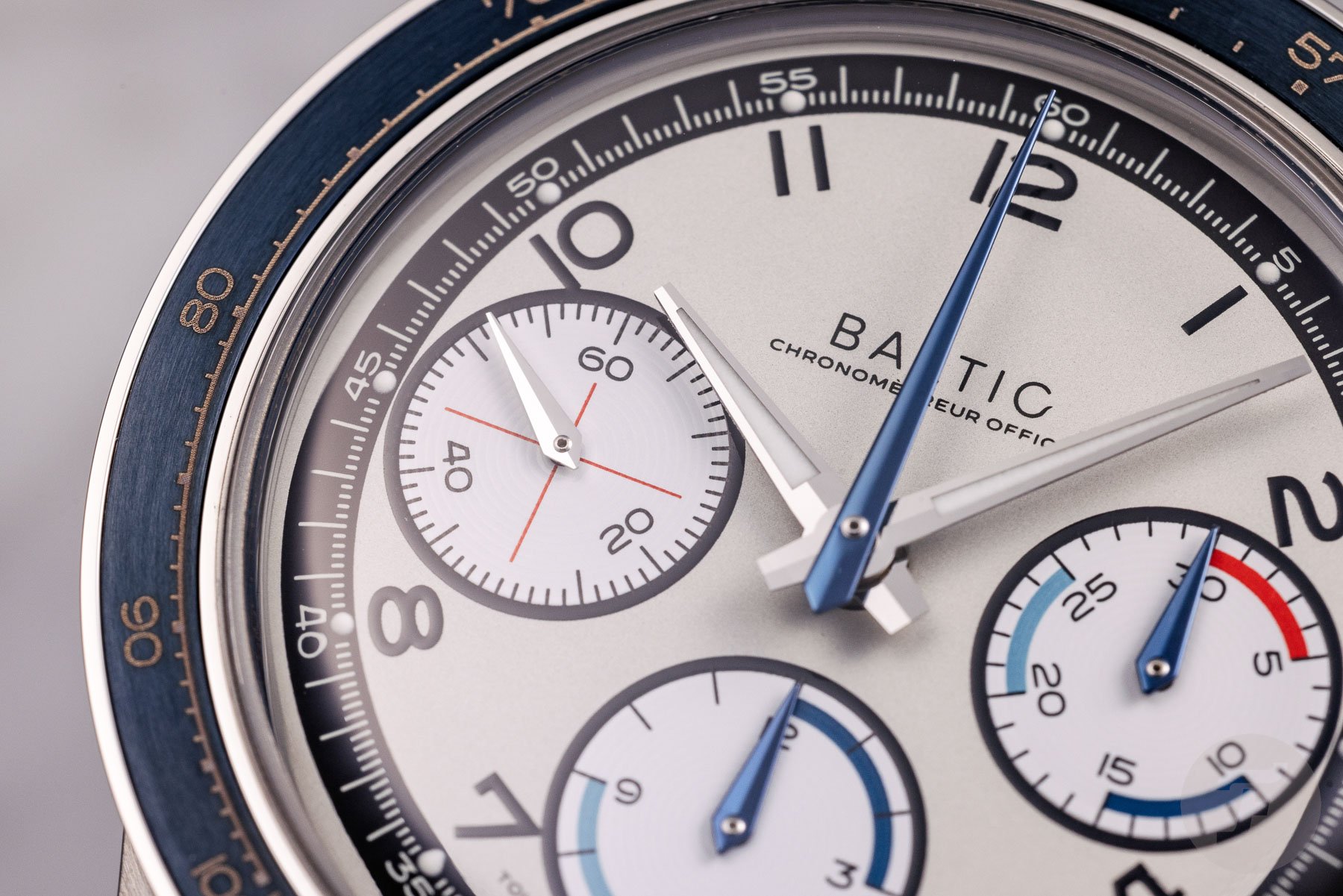 When heritage revival brands do run limited editions at a premium, the premium is accounted for. Baltic’s Tour Auto 2024 Tricompax — SW510, 39.5mm, same architecture as the permanent Scalegraph Classic — carries a ~32% LE premium. That premium buys official Tour Auto timekeeper credentials, a Hanhart flyback stopwatch, a dash clock, and a collector set. Strip out the extras and the watch itself sits at permanent collection pricing. You can see exactly what you are paying for.
The Vulcain Skindiver Chronograph series does not run that way. The Salmon launched in June 2025. The Ice Blue and Green launched together in September 2025. The Blue launches today. Each is 100 pieces. Each carries a premium over the permanent collection. Each deploys the same movement with no additional content. The 100-piece cap is doing the additional pricing work.
The same question was visible inside Vulcain’s own catalogue before the Skindiver Chronograph series existed. When the Chronograph 1970s launched in 2023, Vulcain ran the same structure: a permanent collection base with a limited colourway sitting above it — the Salmon at 50 pieces carrying a premium over the standard variants, same SW510 throughout. Fratello called the base price fair. One reader commented unprompted: “This doesn’t seem to justify the price. It seems just a little basic for two and a half grand.”
The market has offered one clear signal within the Skindiver Chrono series: the Meteorite sold out. Its dial was a Muonionalusta meteorite slice — genuine material differentiation, categorically distinct from anything in the permanent collection. The object earned its premium. The Salmon has been available for twelve months. The Ice Blue and Green for nine months. The colourway premium, unsupported by a specification step-up or additional content, has not generated the same response — all three remain available to purchase today, their runs unexhausted.
In an April 2024 interview with swissinfo.ch, Guillaume Laidet described the opening his brands were built to fill: customers frustrated with established houses “constantly raising their prices and failing to communicate with a new public.” His stated philosophy is to study vintage catalogues faithfully rather than chase shortcuts — a position he holds, by his own account, sincerely.
The Blue is a well-made watch. The archive’s question is a simple one: if the peer set prices this movement architecture at a ceiling Vulcain’s permanent collection is already above, and if the LE premium in this sector is earned through genuine added value rather than a colourway and a unit count, what is the 100-piece cap actually doing? The Meteorite, and Baltic’s Tour Auto, both answered that question by bringing something the specification alone could not. The Blue asks the cap to do that work without the same foundation.
The Archive did not acquire the Blue. The bypass record is here. The secondary market will deliver its verdict over the next twelve months — if the Blue trades consistently above retail on Chrono24, the market will have disagreed with the framework. If it trades at or below retail, the ceiling holds. Either way, The Archive will say so. Check back in June 2027.
