![[ CYBER_ESCAPEMENT ]](https://cyberescapement.com/wp-content/uploads/2026/04/cyber-escapement-long-logo-v5-1.jpg)
[ FIELD_LOG: 002 ]
This series tells the true stories behind the archive — acquisitions, near-misses, methodology decisions, and the role of AI throughout. Each post is a chapter in a collecting philosophy that is systematic, AI-native, investment-disciplined, and honest about all three.
Vienna. Monday, 2nd March 2026. Goldschmiedgasse, the first district. A narrow lane tucked behind the Graben, maybe fifty metres long. Around the corner, Bucherer. Ahead, a door with a small brass plate.
I travel a lot. One of the disciplines I have built around that is simple: before any significant trip, research what watchmaking exists in that place. Not what you can buy anywhere — what you can only find there. The Ianos Dytis came out of a trip to Greece. The logic for Vienna was the same. Austria has a watchmaking tradition that most collectors overlook entirely, dominated as the conversation always is by Switzerland. But Richard and Maria Habring have been building split-seconds chronographs in Graz since 2004, and Uhrmacherei Wien — a specialist dealer in the first district — carries them. That is how the email chain started, on a Monday evening in February: a note to a Vienna dealer asking whether he had a Habring² Doppel-Felix in stock and whether I could come and see it.
He found my email in his junk folder ten days later. He did have one. He would love to show it to me. I could reclaim the VAT.
That exchange is part of the archive now. The approach email, the reply, the confirmation. Before I set foot in the store, there was already a paper trail. That is the discipline.
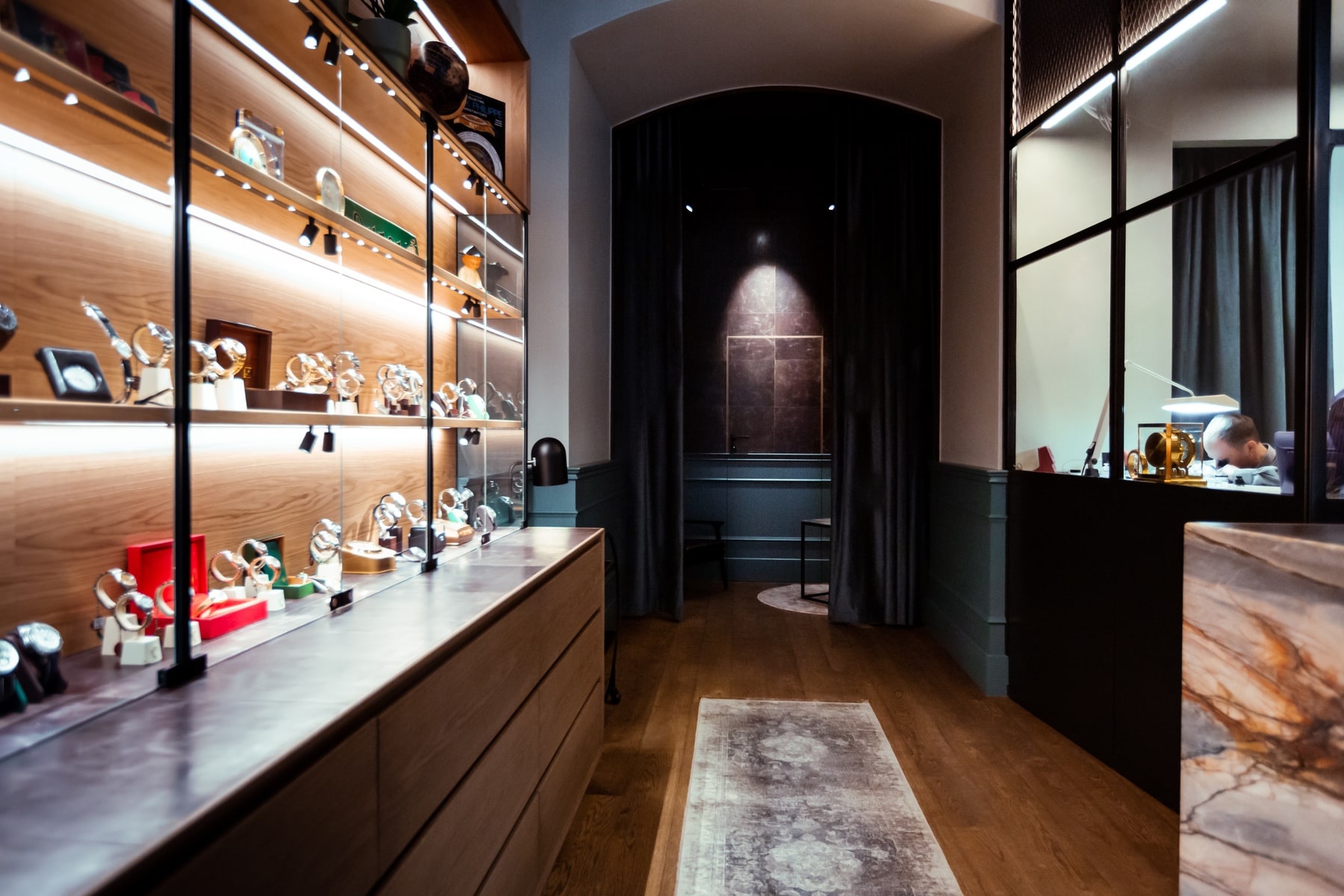
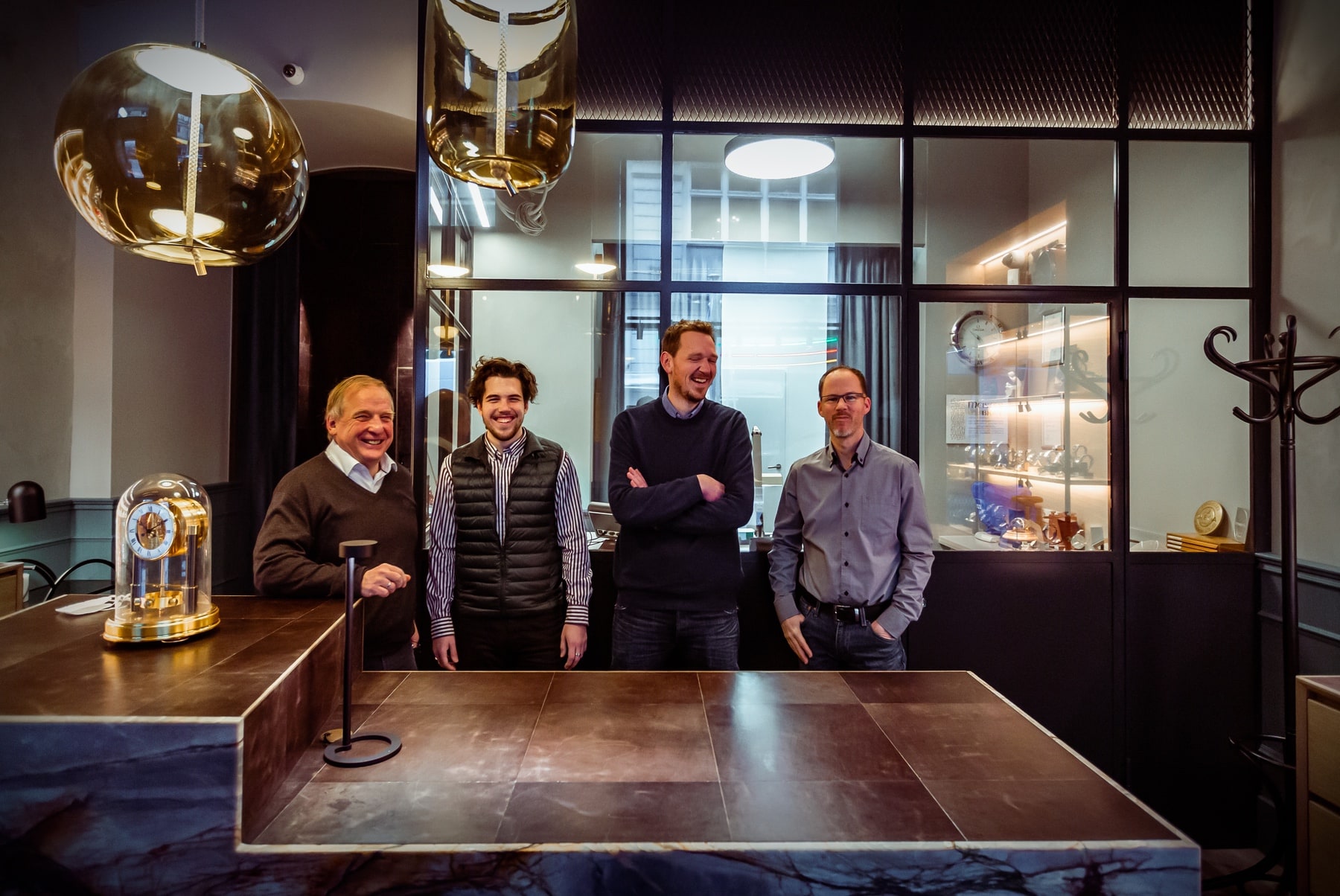 Uhrmacherei Wien is not what Goldschmiedgasse implies. The address suggests imperial grandeur — stone floors, the quiet of old money. The store delivers something more interesting than that. It is a concept space running two businesses in the same room: the trading operation, run by Michael Gunczy — thirty years in the market, specialising in watches with history — and the watchmaking workshop behind a glass partition at the back, where Markus Mayer and his team handle revisions and restorations. A marble island counter in the centre. Warm oak display cases along the walls. Arched ceiling. A working watchmaker visible through glass, bent over a movement under a loupe, while the retail floor operates in front of him.
The stock, mostly, is what you would expect from the address: Rolex, Omega, Panerai, Breitling, IWC. Pre-owned, certified, every piece overhauled in-house before sale.
 Michael knows I am coming. The watch is ready. And this is where the first problem arrives — one that had been building, unnoticed, through the entire email exchange.
The Habring² naming is not straightforward, and it turns out that Michael and I had been talking at cross purposes for two weeks. I thought I was discussing the Doppel-Felix — the 42mm archived reference I had researched, with rose gold hands and markers, a solid steel caseback, no longer in production. Michael thought I was discussing the Doppel 38 — the current model, 38.5mm case with a flared 41mm bezel, the evolved successor. Two different watches. Same conversation. Neither of us had noticed.
Ten minutes of cross-referencing at the counter untangles it. Michael is patient with this. What emerges is that the watch in front of me is the Doppel 38: Calibre A11R_H1, Carl Haas hairspring, amagnetic escapement, sapphire caseback, manual winding. The numbered certificate confirms the model — and the serial: No. 15 of the Doppel 38. One of the first fifteen ever made.
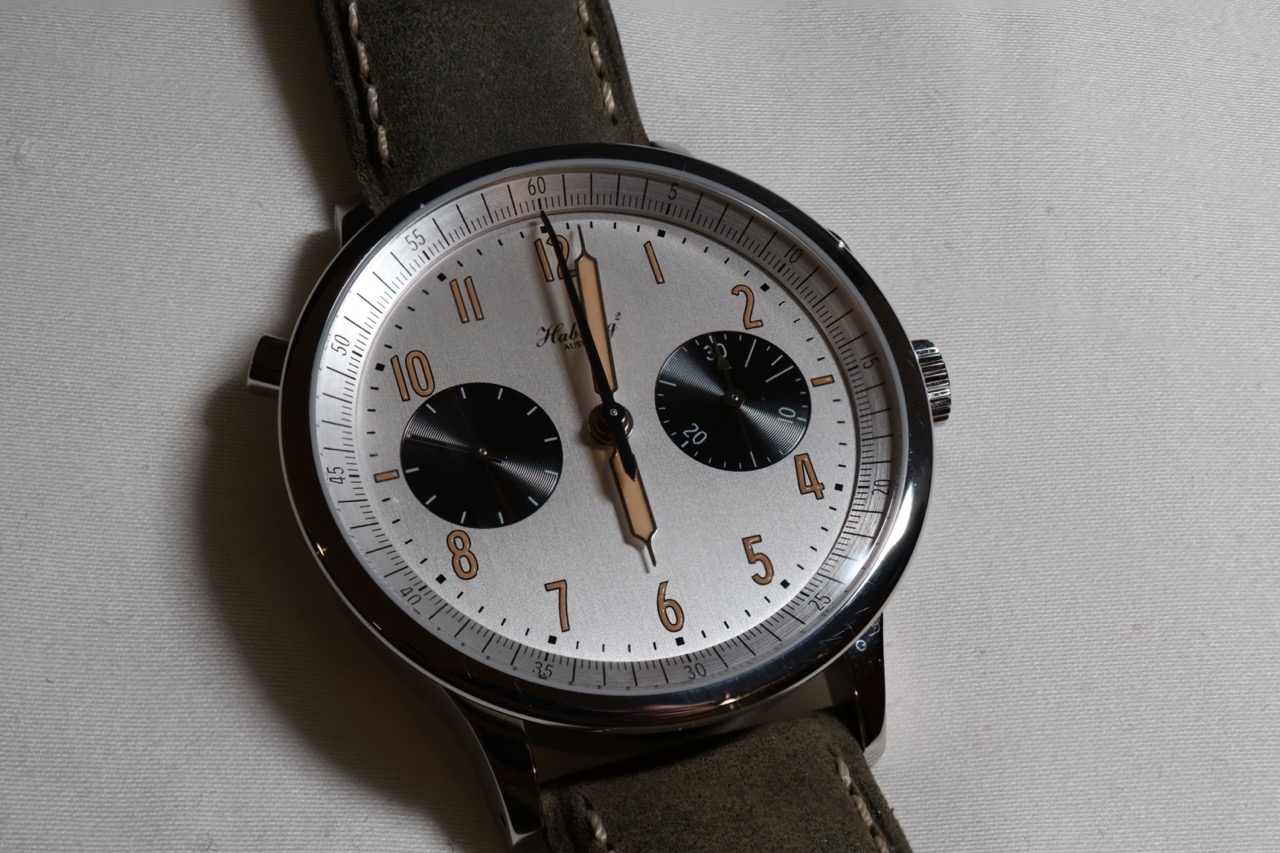 The case is steel, brushed and polished in three parts. The dial is silver with sunken sub-dials and three hands — two heat-blued steel, one red — that catch the light in a way that photographs do not quite capture. The 38.5mm case wears larger than it sounds: the flared 41mm bezel gives it the presence I came for, without the bulk of the older reference. And the split-seconds mechanism is Richard Habring’s own work — a cam-operated rattrapante he originally developed at IWC and has been refining ever since. The Doppel-Felix was the watch I planned to buy. The Doppel 38 No. 15 is a better watch to own. The certificate makes that clear. So does the caseback, the movement visible through it, and the serial number that puts this in the first production run of a reference that will be made for years to come.
I buy the Doppel 38. Michael completes the VAT paperwork — export documentation for a new watch leaving the EU — and throws in an extra leather strap.
 While he works, I browse the shop.
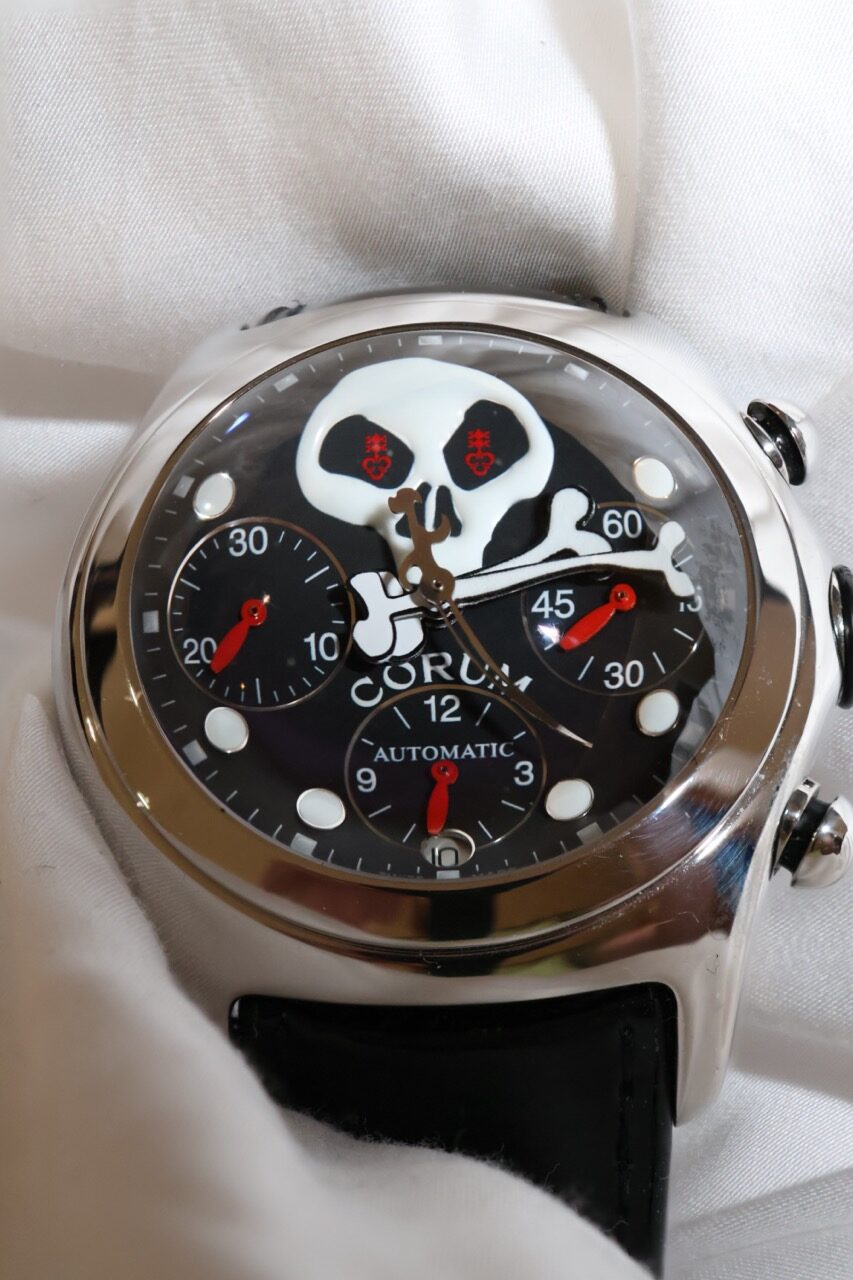
The display cases run along both walls. Most of what is here I have seen before — the standard roster of certified pre-owned, the same references you find in any serious European dealer. But at the far end of the left wall, low down near the floor, something is different. A watch with an enormous domed crystal, the kind that curves so dramatically it distorts everything beneath it. Through the glass, magnified and slightly warped by the dome, a skull and crossbones.
I ask Michael what it is.
He tells me it is a Corum Bubble. I have never heard of Corum. I ask to see it.
Up close, the dome is even more striking — eight millimetres of sapphire crystal acting as a lens, pulling the dial toward you, making the pirate motif fill the eye in a way a flat crystal never could. The skull stares back through convex glass. The chronograph sub-dials sit in the eye sockets. The whole thing is either absurd or brilliant, and I find I cannot quite decide which.
I research it while Michael is still at the counter. The Corum Bubble Jolly Roger Chronograph: a limited edition from the early 2000s, a period when Corum under Severin Wunderman was making watches that looked like nothing else in Switzerland. The secondary market has these at around $4,000. The price on the tag is €2,800.
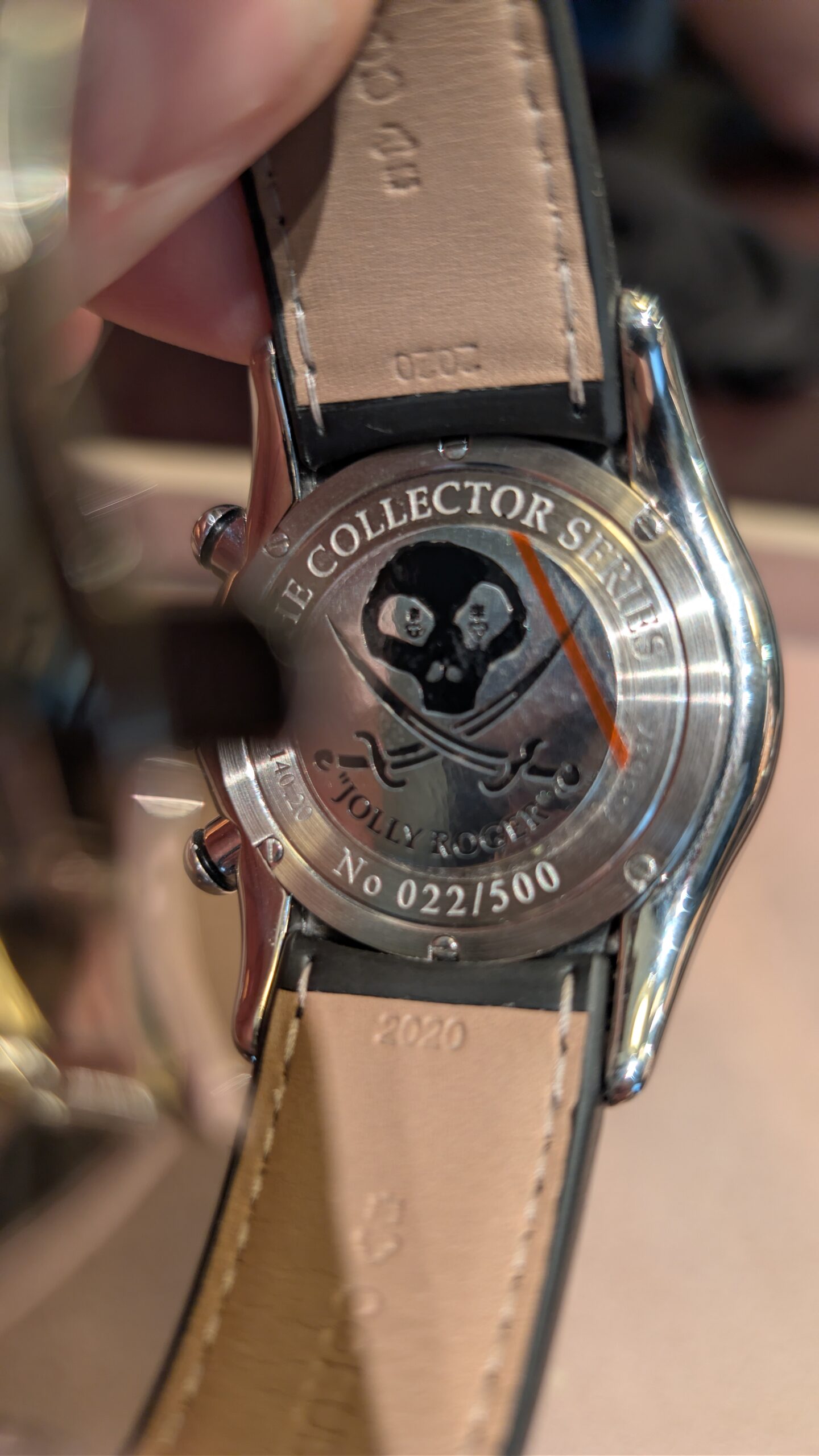 I turn it over. The caseback is engraved: No. 022/500. Five hundred pieces. This is unit twenty-two.
Michael tells me it belonged to a friend of his — someone who needed a way to sell it, and found that having a watch retailer as a friend was the obvious route. No box. No papers. Just the watch. He mentions, volunteering the information, that it has been sitting in that case for around eighteen months.
I had just bought the Habring. I use that fact.
I tell Michael I am happy to take the Corum as well, but given I am buying two watches in the same visit, I would need him to do better on the price. He comes back with €2,200 — what his friend originally wanted for it, he says. The gap between what I am paying and what the market says it is worth is substantial. I say yes.
The VAT paperwork covers the Habring only — new watch, leaving the EU, straightforward export reclaim. The Corum is pre-owned; no VAT to recover. Both clear at the airport without complication.
Afterwards, I have coffee in the square. The kind that comes in a small cup with a glass of water, at a table outside, in early March when Vienna is still cold enough that you keep your coat on. Both watches are in my bag. I had come for one — and not even quite the right one.
I am not a spontaneous buyer. Almost everything in this archive was researched over weeks before a decision was made. The Corum took perhaps twenty minutes from first glance to handshake. What made that possible was not prior knowledge — I had never heard of the reference. It was the willingness to stop, look properly, and investigate before enthusiasm made the decision. The numbered caseback confirmed the scarcity. The Habring receipt provided the leverage. The acquisition alpha was already built in before I handed over the card.
As for the Doppel 38 versus the Doppel-Felix I came for — the archive will have an answer to that eventually. That is what the archive is for.
Postscript — Spetses, Greece. May 2026.
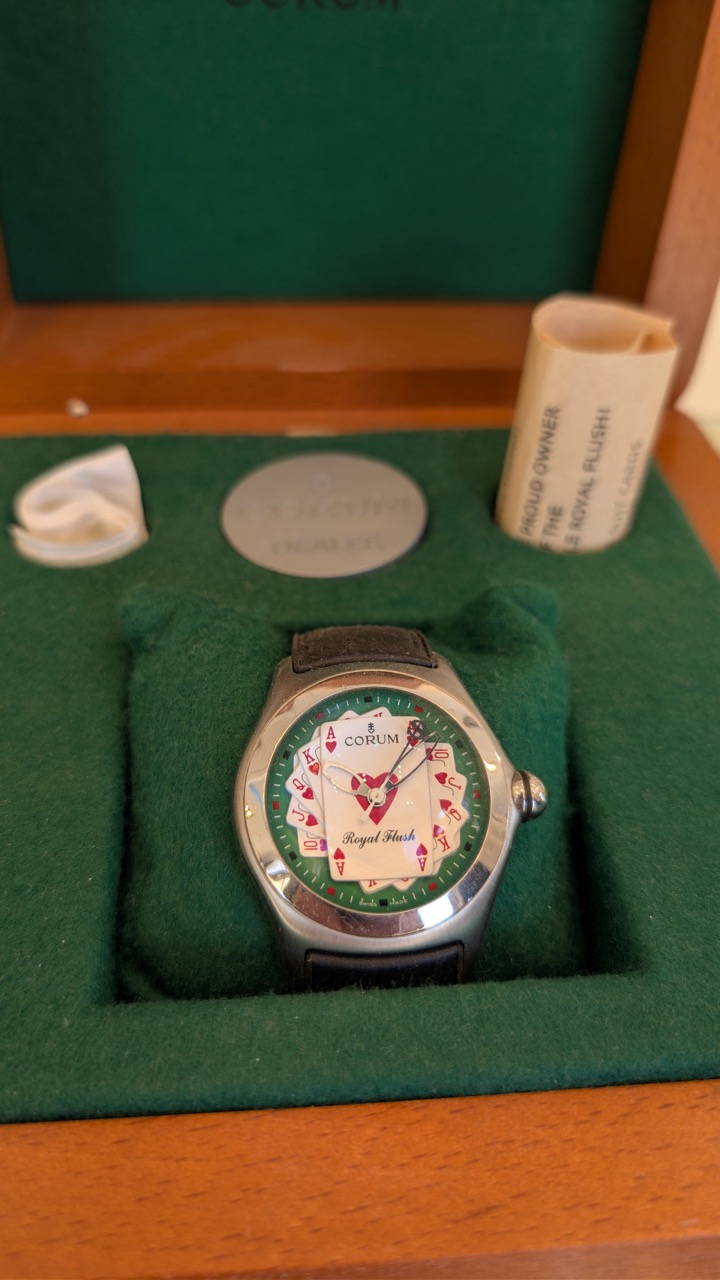 Walking with my wife along the harbour front on the island of Spetses, I stop at a jeweller’s window. Standard tourist stock — nothing remarkable. Then, low down at the front of the display, a cluster of Corum watches. Around ten of them, a mix of new and pre-owned. Someone on this island was at some point a serious Corum retailer, and the stock has never quite cleared. It is an unusual thing to find on a Greek island.
And among them, a familiar dome — but with a different dial.
A Corum Bubble Royal Flush. Full box set. Offered at €5,000. The casino dial, the poker card motifs, the same eight-millimetre sapphire crystal as the Jolly Roger. An appealing object. But the Royal Flush was produced in 2,006 pieces — the edition size matching the year of release, a Corum Collector Series convention. Four times the run of the Jolly Roger’s 500. And the secondary market tells a clear story: full-set examples have been asking $3,500–$4,800 since at least 2018, with confirmed auction results that peaked at around $4,900 in 2008 on novelty premium and have been flat in real terms ever since. At €5,000 in 2026, the ask is above the 2008 nominal peak for an asset with sixteen years of zero appreciation behind it. The movement is the same ETA base as the Jolly Roger. There is no acquisition alpha here — the price dislocation runs the wrong way.
I keep walking.
The Vienna Jolly Roger worked because it was numbered — one of 500 — neglected, and priced below what the market would pay. The Spetses Royal Flush is one of 2,006, offered above what the market has historically paid, in a full box set that commands a premium the secondary data does not support. Same brand. Same Bubble architecture. Same instinct to stop and look. The variable was never the object.
The Royal Flush is formally assessed in the archive — bypassed entry here.
Both Vienna watches are now catalogued. The Habring² Doppel 38 — entry here. The Corum Bubble Jolly Roger Chronograph — entry here.
Preparation does not just help you execute the plan. It helps you recognise when the plan has changed — and sometimes, when the plan was wrong to begin with.
