![[ CYBER_ESCAPEMENT ]](https://cyberescapement.com/wp-content/uploads/2026/04/cyber-escapement-long-logo-v5-1.jpg)
[ FIELD_LOG: 001 ]
This series tells the true stories behind the archive — acquisitions, near-misses, methodology decisions, and the role of AI throughout. Each post is a chapter in a collecting philosophy that is systematic, AI-native, investment-disciplined, and honest about all three.
On Provenance You Cannot Prove
 The birth year watch is a collector’s rite of passage. Find the reference made in the year you were born. Wear the year on your wrist. It is a romantic idea, and I held it for longer than I should have.
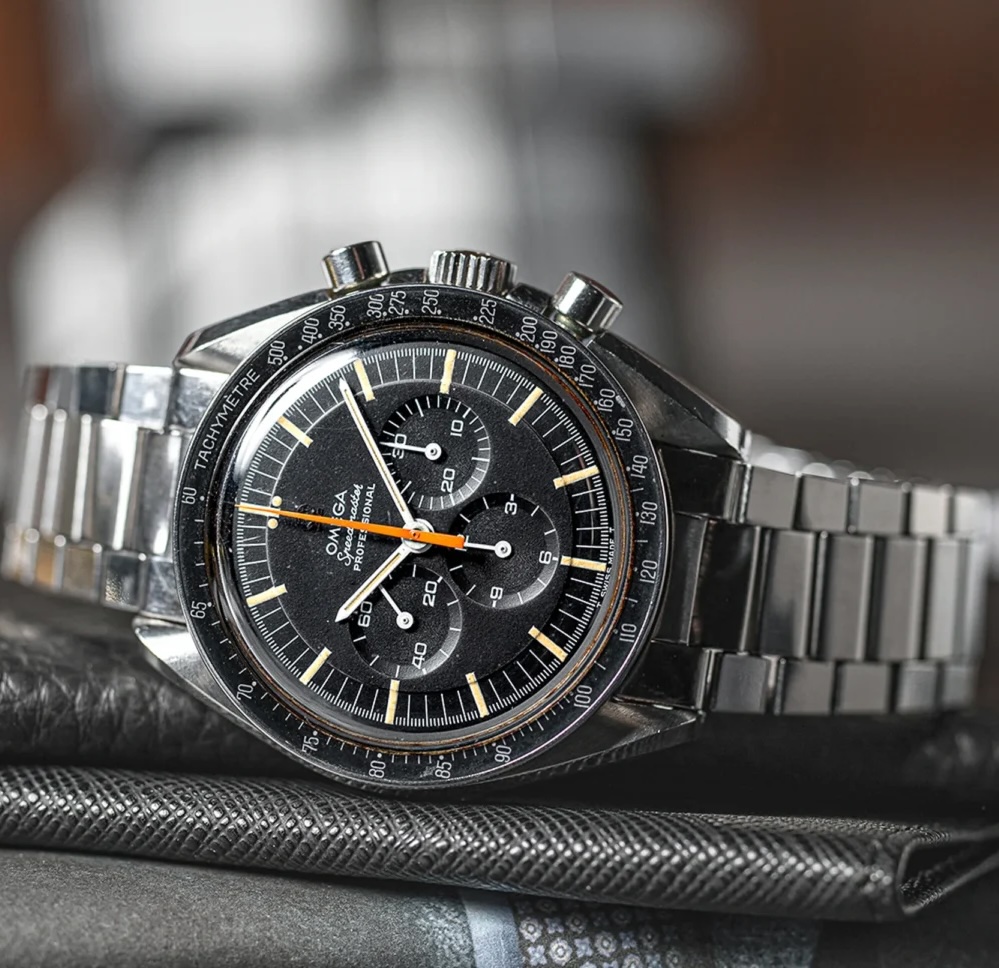
The research took months. The Omega Speedmaster 145.012-67 became the target. The logic had layers: born two years before the moon landings, the birth year reference would predate the achievement itself. Not the watch that went to the moon — the watch from the years when going to the moon was still a thing humanity was working toward. That felt like the more interesting position. Right era, right movement, right aesthetic. The kind of watch that carries genuine history without requiring you to pretend otherwise. I knew the details before I walked into any shop: the dot over 90, the dial configuration, what to look for and what to walk away from.
I had not expected Vienna to be the place.
I was there on a work trip with a colleague, B. He collects vintage. Seriously, knowledgeably, with the kind of patience that only makes sense once you understand that vintage collecting runs on a completely different clock to everything else. He had identified a shop. Chronothek. He had identified a piece he wanted. The Vienna trip gave him the opportunity to go and look at it properly.
 I went with him. He is the reason I walked into that shop at all.
His watch was in the cabinet. I won’t name the reference — that’s his story to tell. What I will say is that it arrived in packaging that made a statement before you even opened it, and the watch inside matched that promise. He examined it the way vintage collectors examine things — methodically, without rushing, communicating nothing to the seller about what he was thinking. By every measure he applies to these decisions, it was the watch.
The price was higher than he wanted to pay. He walked away empty-handed.
While he was doing all of that, I was at another display case across the room. Different Omegas from different eras, arranged without obvious logic. At the bottom, something caught my eye. Black dial, distinctive hands. I asked to see it.
 It was a 67.
The seller knew his stock. He could see I knew the reference. We were having the right conversation.
I noticed a scratch on the bezel. Six o’clock position. I mentioned it.
He said he might have another example from the same year. He went to find it. He came back with a second.
I was examining the two side by side when a third appeared.
And then he brought out the box.
Six columns, five rows. Thirty Speedmasters, all black dials, from across the 1950s and 1960s, laid out in front of me. Different years, different references, the same watch in thirty variations. I stood there and did the arithmetic I should have done months earlier. If there were thirty examples in this shop alone — one shop, one city, one afternoon — how many were there across the market? How many in private hands, in other shops, in other cities? How rare was any individual example, really?
I already knew the answer, because I had just spent real money on a watch that existed in a genuinely small number. The Habring, acquired a few days earlier, was one of a handful. The MING Starfield was already on order — one of twenty. I had been operating in a world where scarcity was specific, documented, finite.
The box made the contrast visible.
Then, openly and practically, he offered a solution to the bezel scratch: he could transfer the bezel from another example. It was a reasonable thing to say. In vintage dealing it is sometimes just how it works — condition is negotiated, parts are sourced. He was not hiding anything.
But what he was describing had a name. Collectors call it a Frankenwatch. A watch assembled from the parts of others — correct components, uncertain origin, a provenance that exists only in pieces. He wasn’t proposing to deceive me. He was proposing something the trade considers entirely normal.
That was enough.
Not because the dealer was dishonest. He wasn’t. But that is precisely the point. The vintage trade operates on knowledge, relationship, and an acceptance that watches accumulate history in ways that are not always linear or documentable. B understands this. It is part of the vocabulary of vintage collecting — you learn to read condition, to ask the right questions, to develop a feel for what has been touched and what hasn’t. He has built that knowledge over years. It is a genuine skill.
I have not built it. And more to the point, the archive I am building does not have room for it.
The framework this archive runs on requires that scarcity be real and documentable. Individual serial records. Timestamped ownership. A chain of custody that can be stated clearly and defended at exit. The moment the dealer offered to transfer that bezel, the possibility of any of that disappeared. Not because he was trying to deceive me. Because that is simply the nature of what vintage is.
A few days later, Chronothek called B. They had the price he wanted.
He said no.
By that point he had watched me acquire the Habring and the Corum on the same trip — two watches with documented scarcity, specific production numbers, theses that could be written down and defended. He knew my collection by then, knew how it was being built and why. Somewhere between the shop and the phone call, the investment question had got into his head. His watch was exactly what he wanted. He knew it wasn’t going to appreciate. He said no anyway.
 He will go back to vintage eventually. It is where his knowledge lives. But that phone call was its own kind of conclusion — a vintage collector who talked himself out of a vintage watch, having spent a week watching someone build a collection on entirely different terms.
I will not go back. Not for that reference, not for that category. The birth year watch idea — romantic, universal, genuinely appealing — did not survive contact with the question this framework always asks first.
What can you prove?
In Vienna, standing in front of the watch I had spent months looking for, the answer was: not enough.
Next: [ FIELD_LOG 002 ] — Vienna, earlier that same afternoon. Two watches, one shop, one very good reason to know what something is worth before the dealer tells you.
