![[ CYBER_ESCAPEMENT ]](https://cyberescapement.com/wp-content/uploads/2026/04/cyber-escapement-long-logo-v5-1.jpg)
[ I. THE_DISRUPTOR_SERIES ]
▪ SERIES_LOG: A collection of fictionalised conversations between opposing advocates, designed to illustrate the friction between established ‘Sovereign’ icons and the ‘Independent Disruptors’ that challenge them.
>> II. SCENE_INGRESS
 Hydra, Greece. No cars, no mopeds — the island runs on foot and donkey, which means it runs on time rather than speed. A harbourside bar in the early evening. The light at this hour does something particular to the Aegean — turns the water a colour that has no precise name in English.
JAMES — an analyst for the Cyber Escapement archive — is three days into a long weekend when NIKOS takes the stool beside him. They’ve met once before, through a mutual contact in the marine salvage world — enough history to skip introductions, not enough to avoid friction. Nikos works logistics for a salvage operation running out of Piraeus. He orders without looking at the menu. He has a Panerai Submersible on his wrist and a tan that comes from the kind of work that doesn’t stop for weather.
Then he looks at James’s wrist. He recognises what he’s looking at. Something shifts in his expression — and then again when Nikos speaks.
>> III. THE DIALOGUE
[ NIKOS ]: “Ianos Dytis. The Antikythera sub-seconds. You know what that mechanism actually was? A tax collector’s tool. The Rhodians used it to calculate the positions of the sun and moon — for religious festivals, yes, but also for trade schedules. It was a commercial instrument. Not exactly the romance your archive is selling.”
[ JAMES ]: “It was a gear-driven analog computer built two thousand years before the Renaissance. Found in a shipwreck off your coastline. If that’s not worth putting on a dial, I’m not sure what is.”
[ NIKOS ]: “What I’m saying is — foreigners love the Antikythera. Greeks see a corroded bronze box that sat in the National Museum for forty years before anyone knew what it was. You’re wearing our history as jewellery. The Panerai has the same problem in Italy, I know — but at least the frogmen were real. The Decima MAS actually used these watches. Men actually went into Alexandria harbour with them. That’s not a story. That’s documented.”
[ JAMES ]: “Documented is a generous word for Panerai’s history. Those early watches — the cases, the movements — were Rolex. Panerai designed the dials and the luminosity. The Oyster case, the waterproofing that actually kept water out — that was Geneva, not Florence. You’re wearing a Rolex with an Italian passport.”
[ NIKOS ]: “And the interface is everything. The crown guard, the luminous compound — those were the parts that mattered at thirty metres in the dark. Nobody cares who made the engine when the brakes are the difference between coming back and not coming back. Panerai solved the problem the diver actually had. The movement was irrelevant.”
[ JAMES ]: “And now the movement they put in the Submersible is a ValFleurier ebauche — the same base calibre Cartier and Baume & Mercier use. Marketed as in-house. The crown guard is still real but the rest of the story has been reconstructed. The 1936 Radiomir date that anchors the whole heritage narrative — serious researchers have been questioning that timeline for years. Panerai post-Richemont looked at what they had and decided the story needed to start earlier than it did.”
[ NIKOS ]: “Every brand polishes its history. You think Ianos Dytis hasn’t made a commercial decision to put the Antikythera on their dial? It’s a Greek watch for people who want to feel connected to something ancient. I’m not saying it’s dishonest. I’m saying it’s the same instinct — reach for the most impressive thing in the archive and put it on your wrist.”
[ JAMES ]: “Except the Ianos references a specific object. A real mechanism, with documented gear ratios, recovered from a specific wreck at a specific depth. The sub-seconds hand at six o’clock is a direct formal reference to the gear train. That’s not branding — that’s scholarship. Panerai’s reference is a category: Italian military diver. Heroic, yes. Specific, no. One of them is pointing at something you can go and look at in a museum two hours from where we’re sitting.”
[ NIKOS ]: “And one of them was worn by men who changed the outcome of a war. I’ll take that over a museum piece.”
[ JAMES ]: “Then buy the history. I’ll keep the archaeology.”
Nikos looks out at the harbour for a moment — at the fishing boats, at the water doing its particular evening thing. He doesn’t concede anything. But he reaches across and tilts James’s wrist slightly toward the light, studying the sub-seconds dial at six o’clock. Holds it there for a moment. Somewhere out in the Aegean, two thousand years and forty-three metres of water separate the mechanism on James’s wrist from the wreck it references. Nikos knows exactly where that wreck is. He’s dived those waters. He lets go of the wrist and picks up his glass without saying anything further. Which is, in its way, a kind of answer.
>> IV. STRESS_TEST_DATA
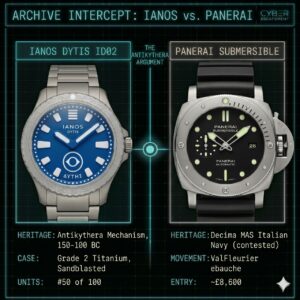
| METRIC | PANERAI SUBMERSIBLE | IANOS DYTIS ID02 |
|---|---|---|
| HERITAGE | Italian Navy frogmen (contested timeline) | Antikythera Mechanism, 150–100 BC (documented) |
| MOVEMENT | ValFleurier ebauche (marketed in-house) | Sellita SW360-1 (manual wind, honest) |
| ENTRY | ~£8,600 | ~£1,750 |
| ALPHA THESIS | Narrative heritage / Sovereign scale | Archaeological specificity / Origin series scarcity |
>> V. CUSTODIAN_VERDICT
“Panerai sells the heroism of men who used the sea as a weapon. Ianos documents the intelligence of men who understood it. Both are valid arguments. But one is pointing at a category. The other is pointing at a specific object, recovered from a specific wreck, at a specific depth — two hours from where this conversation is taking place. That’s not romance. That’s coordinates.”
