![[ CYBER_ESCAPEMENT ]](https://cyberescapement.com/wp-content/uploads/2026/04/cyber-escapement-long-logo-v5-1.jpg)
[ FIELD_LOG: 000 ]
This series tells the true stories behind the archive — acquisitions, near-misses, methodology decisions, and the role of AI throughout. Each post is a chapter in a collecting philosophy that is systematic, AI-native, investment-disciplined, and honest about all three.
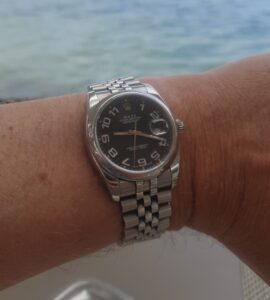
I won the Rolex at work in 2008. A Datejust 36, Reference 116200, with the rare concentric Arabic dial — the kind of detail I did not fully appreciate at the time. It was a prize, not a purchase, which means it was never really chosen. It arrived. I put it on. I wore it every day for the better part of fifteen years and somewhere in that time I stopped thinking of it as a watch and started thinking of it as the watch. You know the distinction.
Two years ago, in Barcelona, someone took it off my wrist. Barcelona has a reputation for this. Its pickpockets are professionals and this one knew exactly what he was looking at. That is the detail that still bothers me more than the theft itself. I was assessed and targeted. It was not random. Someone on a Barcelona street understood the value of what I was wearing better than I did in that moment — which, in retrospect, tells you everything about the danger of obvious objects.
What I felt immediately after was not grief, which would have been appropriate, but anger. Directed not entirely rationally at the brand. As if owning something so legible to a professional thief was itself a kind of mistake. I did not resolve, there and then, never to buy Rolex again. But I resolved clearly not to replace it like for like. I was done with obvious objects.
What followed was not a collecting journey. It was a Fitbit Versa 3.
I travel constantly — almost entirely for work, to destinations across most of the world, more frequently than most people would consider reasonable. In that context, a health tracker seemed practical. Steps, sleep, heart rate — genuinely useful for approximately three weeks, at which point I got used to it and stopped caring. The Versa had a digital-only display that required waving my arm to wake it, which is not a gesture that communicates sophistication in a meeting. I upgraded to a Fossil Gen 6 hybrid, which at least looked like a watch. I found I did not enjoy wearing either of them. There was nothing there. No craft, no history, no reason to look at your wrist other than pure function.
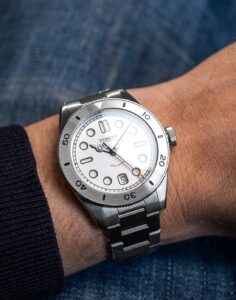
Then the Tusenö Shellback appeared in my Instagram feed.
I do not remember the exact moment. I remember the algorithm deciding I needed to see it repeatedly — which is, in its way, a form of due diligence. It was a clean integrated bracelet watch at around $699 USD. Approachable enough to justify the curiosity. I researched it properly, let the retargeting run its course across several weeks, and ordered on release day.
The duty charge on arrival was 20% on top of the purchase price. A detail I had not fully accounted for. It stung enough to lodge in the memory — and given that I travel constantly for work, to cities across most of the world, it planted something practical. If you are going to pay for a watch, you might as well be there when you collect it. Cork. Vienna. Amsterdam. Athens. Hong Kong, almost. That instinct has served the archive well.
The Tusenö mattered for another reason. It opened the door to the independent world properly — and the YouTube algorithm followed the Instagram algorithm, and suddenly I was watching everything. Micro-brands, allocation windows, independent finishing, the whole vocabulary of a world I had not known existed. Which is how I found myself in Time and Tide in London.

I walked in without a plan and walked out with two watches — a Straum Jan Mayen and a Beaucroft Element 39.5. Both are still in the archive. Neither would clear the framework today. I bought them because they appealed to me — the Straum especially, with its clean integrated bracelet and Nordic restraint. The methodology did not exist yet. There was no scoring system, no logic gates, no exit thesis. There was a shop and two watches and a card machine.
I do not regret either purchase. They continued to open the door. But they taught me something about the difference between buying a watch you like and acquiring an asset you understand — a distinction that did not yet exist in my thinking at that point and exists very precisely in my thinking now.
What pushed me toward precision was a memory. I knew the Datejust I had lost was worth considerably more the day it was stolen than the day I had received it. That appreciation had happened passively, without any thought on my part — I had simply owned the thing and worn it. Someone told me it was worth over $10,000. I took them at their word, as you do when you have not yet learned to verify these things yourself. The number lodged.
If a watch I won as a prize, never chosen, never scored, never analysed, could do that — what might a watch I selected deliberately, acquired at the right price, and held with a clear exit thesis actually achieve?
I put that question to an AI. The answer, eventually, became the archive.
January 2026. This is when it properly begins.

I started working with AI — Gemini first, then Claude — not to search for watches but to think about them. The distinction matters. A search engine finds what you already know to look for. A thinking partner finds the edges of what you do not know yet. The question ‘what watch should I buy?’ produces a list. The question ‘what makes a watch a defensible long-term asset at this price point?’ produces a framework.
The framework took months to develop and went through several versions. In its earlier iterations it would have cleared the Green Fifteen without flagging the issues that V.A.U.L.T. v4.3 now catches and explains precisely. The current version knows better because the earlier versions were tested against real acquisitions and found wanting. The watches taught the framework where it was wrong.
Cork. Vienna. Athens. Heathrow. Hong Kong, almost. Each acquisition is a chapter. Each one went through the framework. Each one has a story the framework alone cannot tell — a broker in a Starbucks, a box of thirty vintage watches in a Viennese back room, a sub-seconds hand at 6 o’clock wearing it in the city it references.
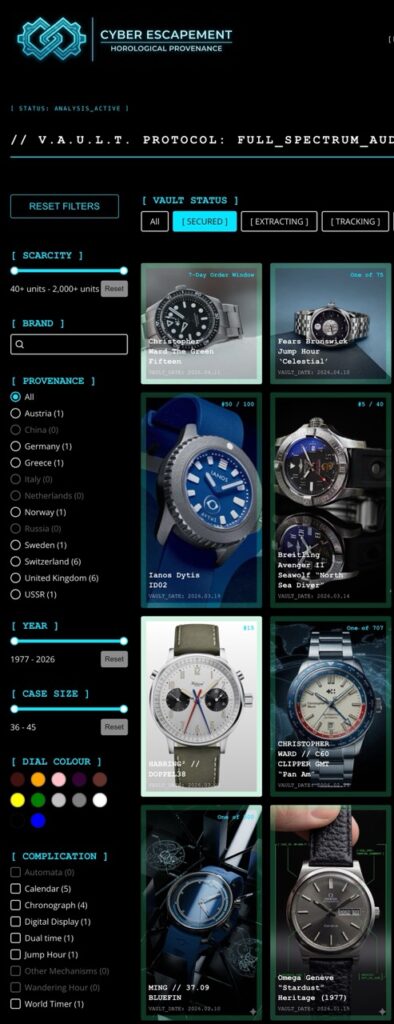
The archive now holds eighteen secured assets and a further ten in active extraction. Every one was acquired with AI assistance — not as a novelty, not as a shortcut, but as a genuine analytical partner present at every acquisition decision.
I still wear them. The Tusenö is on my wrist as I write this — the watch that started all of it, still earning its place. The Green Fifteen came out last week. The Fears Brunswick jump hour went to a black tie dinner recently and drew exactly the conversation a jumping hour at a black tie dinner deserves. The Ianos goes to Greece in a few weeks, which seems correct. The Pan Am comes on transatlantic flights. The Breitling Concorde has been in the BA Concorde Room at Heathrow, photographed against the nose cone — either the most appropriate provenance documentation in the archive or the most self-indulgent, probably both.
These are assets. But they are also objects that exist in the world, on a wrist, in places that give them context. The framework scores the investment case. The wearing builds the provenance record. They are not separate activities.
I have not sold anything yet. The exits begin in 2027. The archive will be honest about those too — what the framework predicted, what the market delivered, where they diverged and why.
One final note on the Datejust. I ran the 116200 with the concentric Arabic dial through the same AI tools I now use to build this archive. The current secondary market: $7,500 to $9,800. Active listings, steady demand, holding above original retail. Appreciating — but not the $10,000 plus I had been told to expect.
The watch I lost is worth less than I thought. The archive I built in its place is worth considerably more. And unlike the Datejust, I know exactly why.
