![[ CYBER_ESCAPEMENT ]](https://cyberescapement.com/wp-content/uploads/2026/04/cyber-escapement-long-logo-v5-1.jpg)
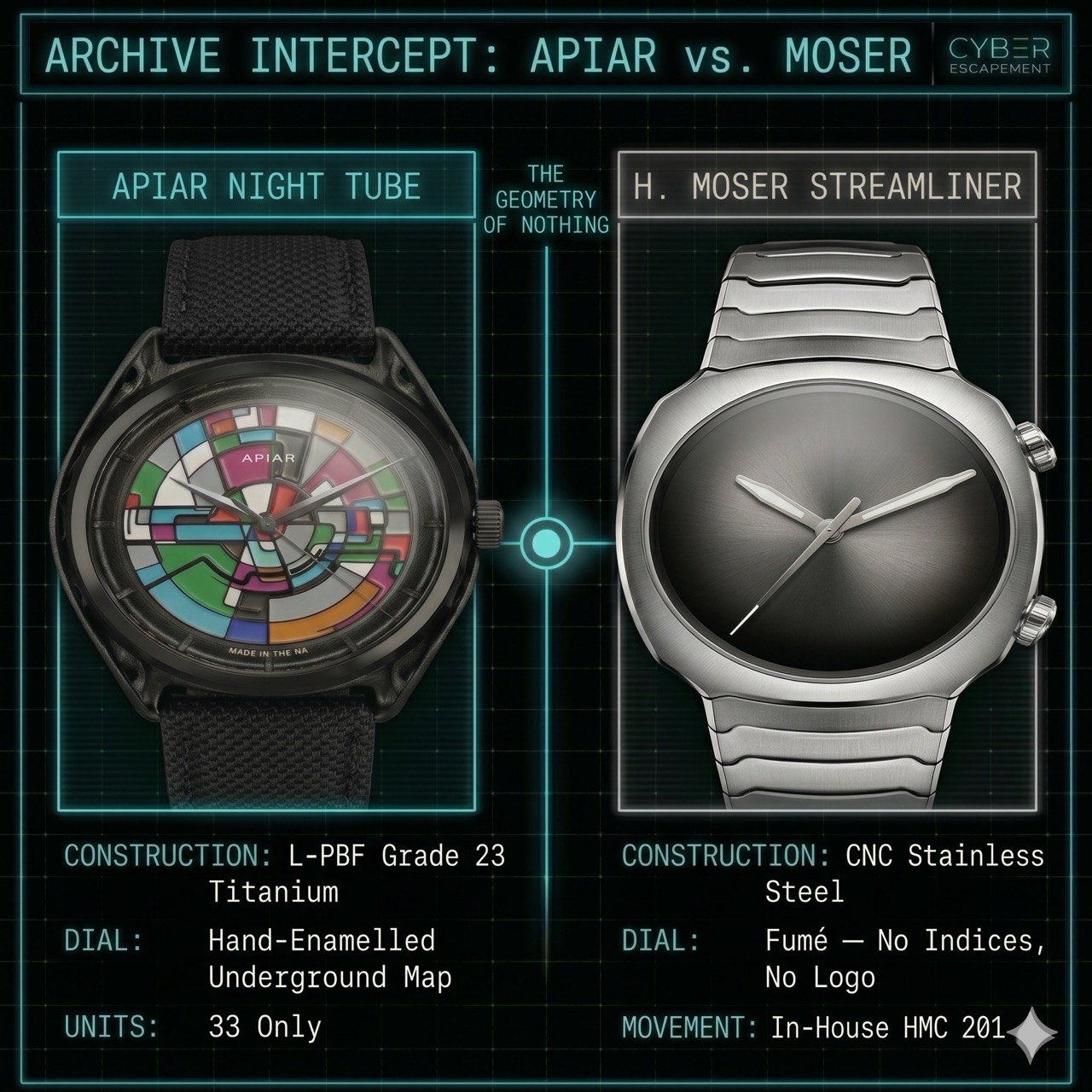
>> I. SCENE_INGRESS:
King’s Cross St. Pancras, Northern Line platform. 22:14. The southbound indicator reads three minutes. The platform is half-empty — the particular quietness of the Underground after the theatre crowds have thinned.
JAMES — an analyst for the Cyber Escapement archive — is waiting for a southbound train when DANIEL comes through the barrier, slightly breathless. Old friend, private banking. He’d missed a cab on Euston Road and taken a gamble on the Underground. They hadn’t planned to meet.
They fall into the easy rhythm of people who know each other well enough not to need preamble — a client dinner Daniel had escaped from, a project review James was still half-thinking about, the usual. It’s only when Daniel checks the time that things shift. He glances at his own wrist — the H. Moser & Cie Streamliner, fumé dial, brushed integrated bracelet — and then at James’s. He doesn’t recognise what he’s looking at. He looks again.
The train arrives. They get on. The argument runs to Waterloo.
[ DANIEL ]: “What on earth is that? It looks like a Transit Authority lanyard.”
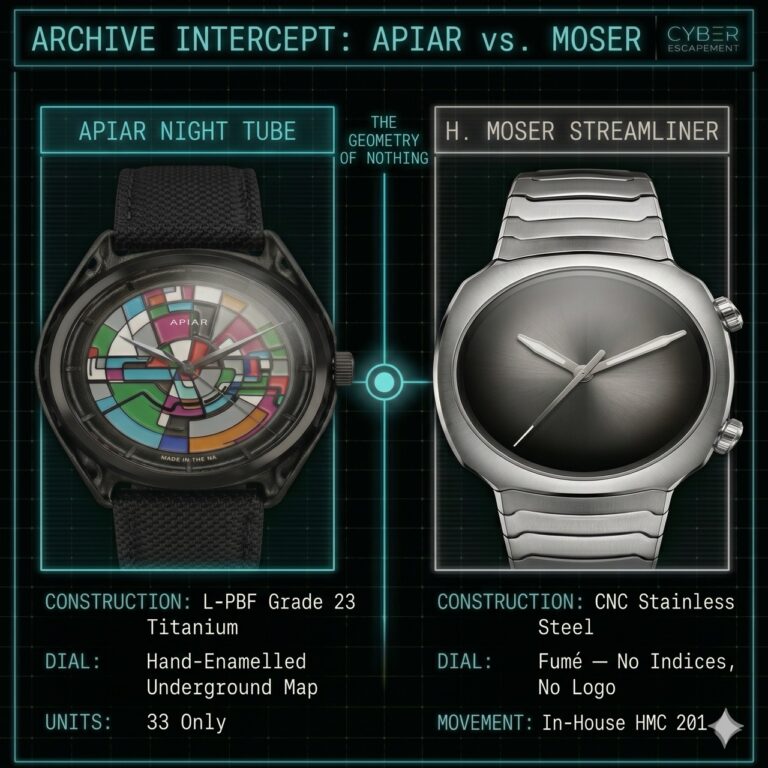
[ JAMES ]: “It’s an Apiar. Thirty-three units. The dial is the Northern Line map — hand-filled enamel, every station. You’re standing on it right now.”
[ DANIEL ]: “I see that. My point is — why? You have a watch that tells the time by showing you where you are. In a tunnel. At eleven at night.”
[ JAMES ]: “The case is 3D-printed Grade 23 titanium. Laser powder bed fusion — geometries you literally cannot cut from a billet. The hollow lattice structure in the lugs doesn’t exist in your Swiss toolbox. It can’t. A CNC mill removes material. This process builds it atom by atom. The watch is lighter than your keys.”
[ DANIEL ]: “And Moser removes the logo entirely. Removes the indices. Removes everything the industry uses as a crutch, until all that’s left is the fumé dial and the movement. Edouard Meylan’s whole argument is that a product should be recognisable by its design alone — not by what you’ve bolted onto it. That’s a harder discipline than addition.”
[ JAMES ]: “It’s a beautiful watch. I’m not arguing that. But Moser’s minimalism is a surface decision — you’re removing visual noise from a conventional case construction. Apiar’s complexity goes the other direction. The structure itself is the argument. Those lattice geometries aren’t decoration. They’re load-bearing. You can’t fake them with finishing.”
[ DANIEL ]: “The HMC 201 movement is produced entirely within the MELB holding group. In-house hairspring. In-house regulating organ. Moser is one of the only independents genuinely doing vertical integration at that level — and they’re doing it at forty millimetres, water resistant to 120 metres. That’s not surface discipline. That’s a decade of investment hidden under a smoked dial.”
[ JAMES ]: “Hidden is the right word. You’re paying around £20k to be told that the complexity is there — you just can’t see it. The Apiar is £2,500 and the complexity is right in front of you. Thirty-three units. A dial assembled by hand by Chris Alexander, station by station. The number 33 — that’s the average speed of this line in kilometres per hour. That’s not branding. That’s the watch knowing where it lives.”
[ DANIEL ]: “The Gateway Independent, they call it — the Streamliner. The watch that sits above Rolex in seriousness without requiring you to remortgage for Patek. That positioning exists because the substance is real. Meylan once made a watch out of Swiss cheese to mock the industry’s reliance on the Swiss Made label. He’s been attacking his own sector for a decade because he thinks most of it is branding over product. And then he goes and builds a movement with a proprietary double hairspring. That’s not irony. That’s confidence.”
[ JAMES ]: “And Apiar builds in Wales. Gloucester. Newcastle. The 33 units aren’t a marketing decision — there are genuinely only 33 people in the world who can wear the Northern Line on their wrist. When the Streamliner sells out, Moser makes more. When the Night Tube sold out, that was it. The dial is the archive. The watch is the document.”
[ DANIEL ]: “You’re describing scarcity as a virtue in itself. That’s a dangerous argument. Thirty-three units means thirty-three potential buyers — worldwide. What’s the exit if you ever need liquidity? You’re not wearing a watch, you’re wearing a very elegant problem.”
[ JAMES ]: “The Streamliner has a secondary market. The Night Tube has a waiting list. There’s a difference.”
The train slows into Waterloo. Daniel stands, straightens his jacket. He glances down at the Apiar one more time — at the hand-filled enamel stations, at the lattice lugs just visible at the case edge, at the dial that knows exactly where it is. He doesn’t say anything else about it. But on the escalator up to the Jubilee line, James notices him look at his own wrist — at the flawless, smoke-graduated fumé, at the watch that hides everything it knows — and hold it there for a moment longer than necessary. The geometry of nothing. The geometry of everything. Same platform, different philosophy, thirty-two stops apart.
>> II. STRESS_TEST_DATA:
| METRIC | H. MOSER STREAMLINER | APIAR GEN1.1 NIGHT TUBE |
|---|---|---|
| CONSTRUCTION | CNC-machined steel, subtractive | L-PBF Grade 23 Ti, additive |
| PHILOSOPHY | Complexity hidden (fumé subtraction) | Complexity visible (lattice addition) |
| ENTRY | ~£20k | £2,500 (ex-VAT) |
| ALPHA_THESIS | Vertical integration / Sovereign prestige | Absolute scarcity / Additive moat |
[ III. CUSTODIAN_VERDICT ]
“The Apiar Night Tube and the Moser Streamliner are both making the same argument in opposite directions: that the watch industry’s defaults are wrong. Moser proves it by removing everything. Apiar proves it by building what the industry structurally cannot. One hides its intelligence behind a smoked dial. The other wears it in the geometry of the case. Both are right. Only one of them costs less than a used hatchback.”
[ IV. THE_DISRUPTOR_SERIES ]
| ▪SERIES_LOG: | A collection of fictionalised conversations between opposing advocates, designed to illustrate the friction between established ‘Sovereign’ icons and the ‘Independent Disruptors’ that challenge them. |
